What does this problem actually mean?
It means people are reading blog posts, but those sessions are not turning into local customers — usually because the traffic was never a local buying job.
A plumber’s guide to “how a water heater works” can attract readers nationwide. A dentist’s explainer of “what Invisalign feels like” can rank for research queries from people who will never book in your suburb. Sessions are not enquiries. Measure the path before concluding that Local SEO is broken.
Does this mean Local SEO failed?
No. Local SEO is about being findable for local commercial jobs. Blog traffic is often a different intent.
If Maps, the Business Profile and service pages are the surfaces you expected to produce customers, diagnose those separately. How to tell whether Local SEO is producing leads is a measurement question: is Local SEO generating leads. Google does not guarantee that helpful articles will create bookings. Source: How Search works.
Intent
What did they search? How-to queries often stop at the answer. Service queries want a booking path.Place
Are they in the service area? National how-to traffic will not fill a local diary.URL
Is the blog ranking for the service? If the post wins the service query, the service page may be the weaker document.Yes
Fix the path you confirmed Internal links, CTAs and the service URL — not more generic posts.Next
Do not treat education as failure Awareness content can be useful without being a lead engine.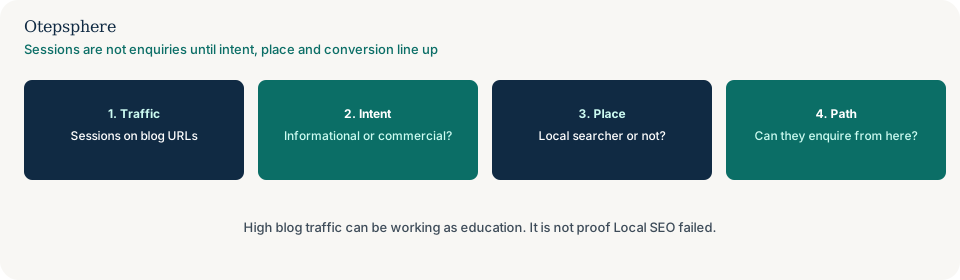
Is this the same as visibility without leads?
No. Overall Google visibility without customers is a journey problem across listings and landing pages, not specifically blog intent.
If the complaint is “we appear in Search or Maps but nobody enquires,” start with why Google visibility does not create customers. A location or service URL that already has sessions and still produces almost no calls is why a local landing page gets traffic but almost no calls. This article stays with blog URLs that attract sessions which were never in a position to become local enquiries.
Is this the same as the wrong commercial leads?
No. Wrong commercial leads are people who do enquire — for the wrong service, city or job. Blog traffic with no local customers often never reaches the form.
If the phone is ringing with jobs you cannot take, use why Local SEO can bring the wrong leads. If the blog is busy and the diary is empty, stay on intent, geography and conversion below.
What intent did the posts attract?
Most under-converting blogs attract informational queries: how-to, definitions, comparisons and news, not “plumber near me” or “book a dental exam.”
In Search Console, filter to the blog directory. If top queries are “how to unblock a drain” or “Invisalign vs braces,” the page did its informational job. That is useful content strategy, not proof the service pages failed. People-first guidance still applies: the post should help the reader in front of it. Source: Creating helpful, reliable, people-first content.
Were the searchers local?
Often they were not. Queries without a place name can be searched from anywhere, and analytics location is not the same as “this person could visit your premises.”
A post can rank nationally while your customers are suburban. Check whether queries include your city, whether service pages — not the blog — receive those local commercial queries, and whether the Business Profile is the surface locals actually use. Do not treat country-wide pageviews as a local lead forecast.
Could they enquire from those pages?
Only if the post makes the local offer obvious and the next step is usable. Many blogs never present a booking path because they were written as articles, not as service pages.
Look for a clear service, a relevant location, and a phone or form that still works on a phone. A generic “contact us” in the footer is easy to miss. Soft links into the matching service URL can help readers who are ready; stuffing every post with suburb keywords does not.
Intent × geography × conversion table
| What you see | Intent | Geography | What to do next |
|---|---|---|---|
| High sessions, how-to queries, no enquiries | Informational | Often anywhere | Keep the article if it helps; do not treat it as a lead channel. Link to the service page for readers who become ready. |
| Queries include your city, but the blog URL is ranking instead of the service page | Mixed or commercial | Local | Strengthen the service URL and internal links. The blog may be the wrong document for that job. |
| Local queries, local sessions, no form fills | Commercial enough | Local | Fix the conversion path on those posts: offer, hours, phone, form. Measure calls and forms before rewriting topics. |
| Traffic from other countries or cities you do not serve | Usually informational | Not your market | Do not optimise the blog to “capture” them. Service boundaries belong on service and location pages. |
What should I not do?
Action checklist
- Export blog queries from Search Console. Label each informational, commercial or brand.
- Note whether queries and analytics suggest local searchers, or readers from anywhere.
- Open the top landing posts and test the enquiry path on a phone.
- Check whether commercial local queries are landing on the blog instead of a service or location URL.
- Keep useful informational posts. Add a clear next step only where the reader might actually book.
- Measure enquiries from those URLs. Sessions alone are not a Local SEO result.
When professional help makes sense
Help is useful when blog sessions are being counted as Local SEO success, when commercial queries are landing on articles instead of service pages, or when intent, geography and conversion have not been separated. It cannot guarantee that blog traffic will become local enquiries.
Sources and further reading
- Google Search Central: How Search works
- Google Search Central: Creating helpful, reliable, people-first content
- Google Search Central: Google Search Essentials
Blog sessions not becoming local enquiries?
Otepsphere can review the queries, landing pages and conversion path — so you can see whether those sessions were ever in a position to enquire, without treating pageviews as leads.
Contact OtepspherePublished by Otepsphere
Published by Otepsphere, founded by Joseph Enmanuel. Learn about Otepsphere and its approach to local SEO.